What this really is
Not a lecture. A seat at the investors' table.
For ninety minutes, people who have actually written checks and built companies tell you how the money really moves. Two kinds of people should be in this room.
Learn how an investor thinks before you ask.
- What an investor is trying to figure out in the first 10 or 15 minutes with a founder
- How startups actually raise money, and whether that applies to your business
- How to read a pitch, and pointers on giving one
- What due diligence means for you as the founder
- Where valuation and term sheets come into play
You do not have to be a millionaire.
- Who can be an angel: accredited and non-accredited investors
- What you learn by starting with a small check
- Why many angels invest together as a group
- What mistake to avoid on your first investment
- How to judge whether a founder can actually get customers
"You aren't just investing in a company. You're investing in an entrepreneur, an idea, and the possibility of what that business could become."Ngozi Bell, moderator
Angel investing, explained
An angel puts their own money into an early-stage company.
In return they get an ownership stake, or another form of startup investment, usually well before the company is widely known. Here is how it works, in the seven steps from Ngozi Bell's primer.
Find
Hear about a young company that is raising money. Often founders come to angels known for a certain field.
Learn
Evaluate the founders, the market, the numbers and the opportunity.
Ask questions
What are they building, who needs it, how big could it get, and why is this the right team?
Decide
Is this an investment you can stand behind?
Invest
Put in only an amount you are comfortable putting at risk. This is patient money.
Support
Many angels also become a mentor, connector or advocate for the company.
Wait
Some companies will not make it, some do well, and once in a while one changes everything.
Then decide together
Whether angel investing is something you want to pursue, alone or as a group.
The bigger picture
Angels are one road to capital.
Every business funds itself somehow. Knowing all the roads helps you pick the right one for where you are.
Revenue
Customers paying you. The cheapest money there is, and what every investor wants to see first.
Grants
Money you do not pay back, usually tied to a program, a mission or a place.
Loans
Banks, SBA-backed loans and community lenders. You keep ownership and pay it back with interest.
Angel investors
Individuals investing their own money early, for a share of what you build.
Venture capital
Funds investing other people's money in companies built to grow very fast.
At the table
People who have done it.
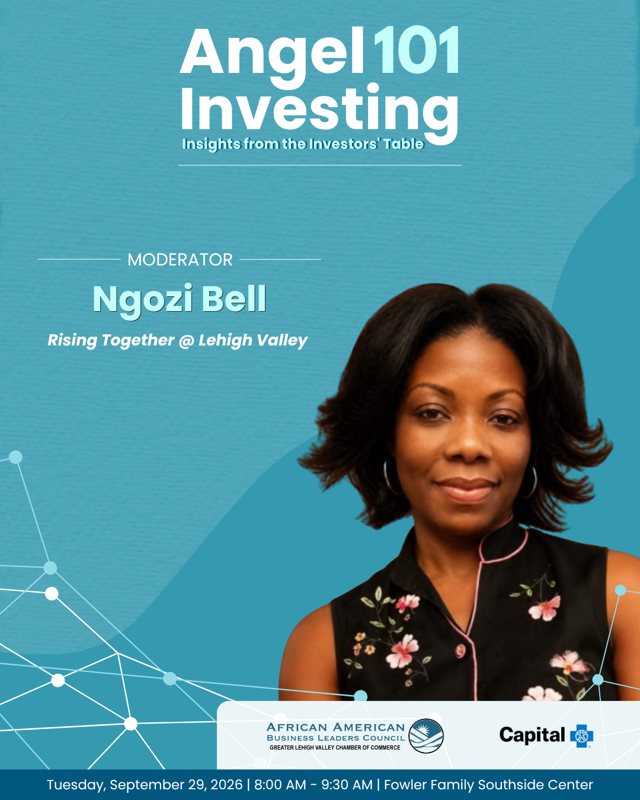
Ngozi Bell
Rising Together @ Lehigh Valley. Author of the Angel Investing 101 primer.
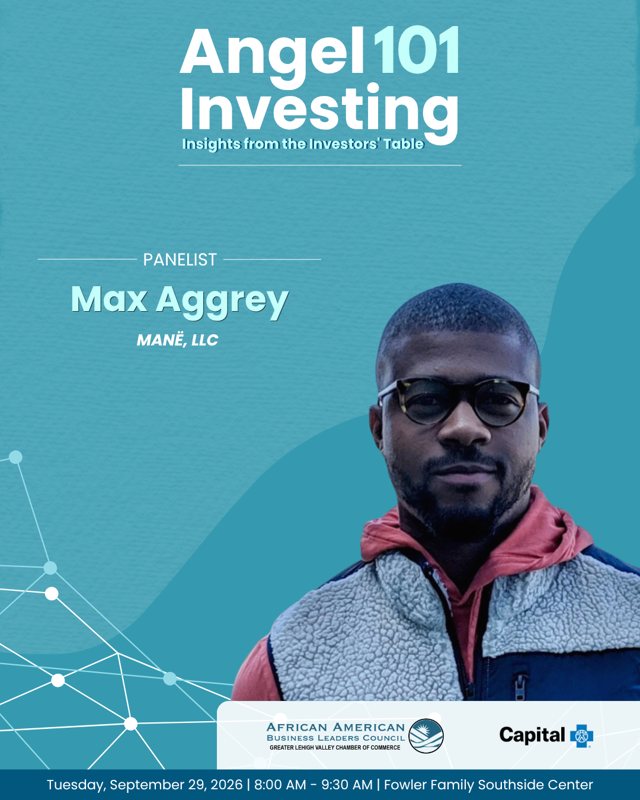
Max Aggrey
MANĒ, LLC. Equity research at UBS, strategic partnerships at LiveRamp and Google, founder and angel investor.
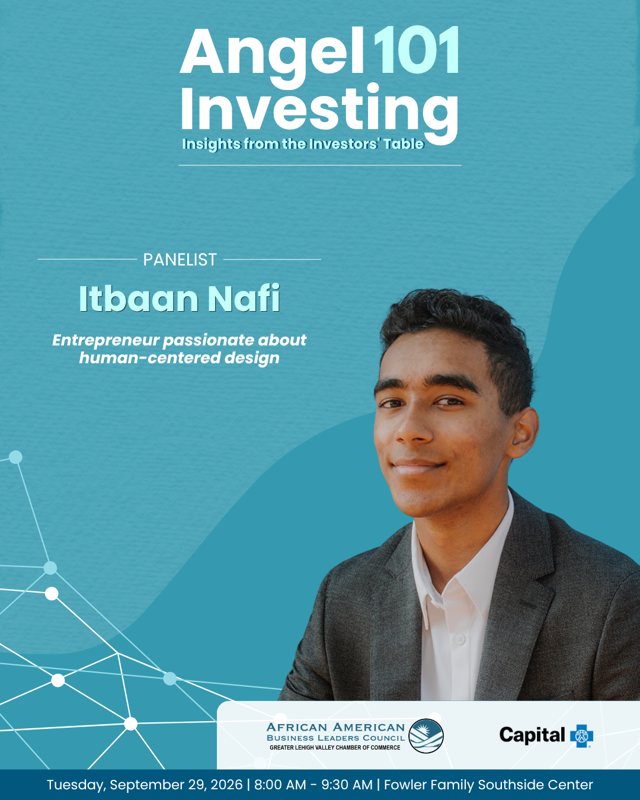
Itbaan Nafi
Entrepreneur passionate about human-centered design, building an investment ecosystem around very early-stage and student founders.
Questions on the table
What you will walk out knowing.
- Who is an angel: accredited versus non-accredited?
- What is a startup anyway? Only tech companies?
- How do startups raise money?
- How do you read a pitch, and how do you give one?
- What makes a good founder?
- How do angels evaluate a market?
- What does due diligence really involve?
- Where do valuation and term sheets come in?
Tuesday, September 29 · 8 am
Pull up a chair at the table.
Fowler Family Southside Center, 511 E. Third St., Bethlehem, or join on Zoom. $25 in person, $20 on Zoom.
Register nowWith support from Capital Blue.